
APEX EXPO 2025: Airlines Chart the Future of Passenger Connectivity
Originally published on APEX
At the 2025 APEX Global Expo, connectivity once again took center stage. Wednesday’s panel, moderated by Seth Miller of PaxEx.Aero, brought together three leaders with very different perspectives: flyadeal CEO Steven Greenway; IAG Performance and Operations Manager IFEC Strategy Mark Cheyney; and SAS Scandinavian Airlines VP Product and Loyalty Aron Backstrom.
Together, they explored how satellite innovations, operational use cases, and shifting passenger expectations are shaping the next decade of in-flight connectivity. The discussion highlighted both the opportunities and the hurdles as airlines face the growing demand for seamless, consistent, and affordable Wi-Fi in the skies.
Shifting Passenger Expectations
Miller opened the discussion by pointing to the different stages of adoption among the panelists. SAS has offered connectivity for more than seven years; IAG airlines have cycled through multiple providers; and flyadeal only recently reconsidered its earlier stance that connectivity was unnecessary for short-haul, low-cost operations.
Cheyney explained how IAG has redefined its approach since selecting its first systems nearly a decade ago. “What customers do now, and what customers are going to be doing in the future, is very different from 2015 or 2016,” he said. “We are working with innovation teams internally around trends like AR, wearables, and shopification on social media platforms. The systems we select now have to position us to deliver on those expectations.”

Pictured, PaxEx.aero Editor Seth Miller. All photos via Caught in the Moment Photography
For SAS, the real pain point has been consistency. “Right now, we operate with three different providers, each with different levels of product experience,” Backstrom noted. “On top of that, quite a few aircraft are unequipped, and every day we have some that are broken. The customer has no idea what kind of connectivity they will get, which removes a lot of value. It is almost impossible to get someone to pay for it when you cannot guarantee the service.”
Greenway acknowledged that flyadeal’s circumstances have shifted. “We are a domestic carrier with stage lengths of no more than an hour and a half. No matter how addicted you are to your phone, connectivity for that short a time is not critical,” he said. “But now the A321XLRs are coming, giving us up to six hours’ flying time. We have ordered Airbus A330neos that will fly 12 hours. Suddenly, the discussion is different.”
The Appeal of Free Wi-Fi’ vs. Reality
A recurring theme was the business model behind connectivity. Passengers increasingly expect Wi-Fi to be free, yet the costs for airlines remain significant.
“The first rule of free Wi-Fi is that it is not free,” Cheyney said. “Someone has to pay. Sponsorships and partnerships can offset part of the cost, but I have not seen anywhere that will cover all of it. Airlines will still have to eat a chunk of it themselves.”
Backstrom agreed: “You need to believe this drives ticket revenue or customer choice. Otherwise, it does not make sense.”

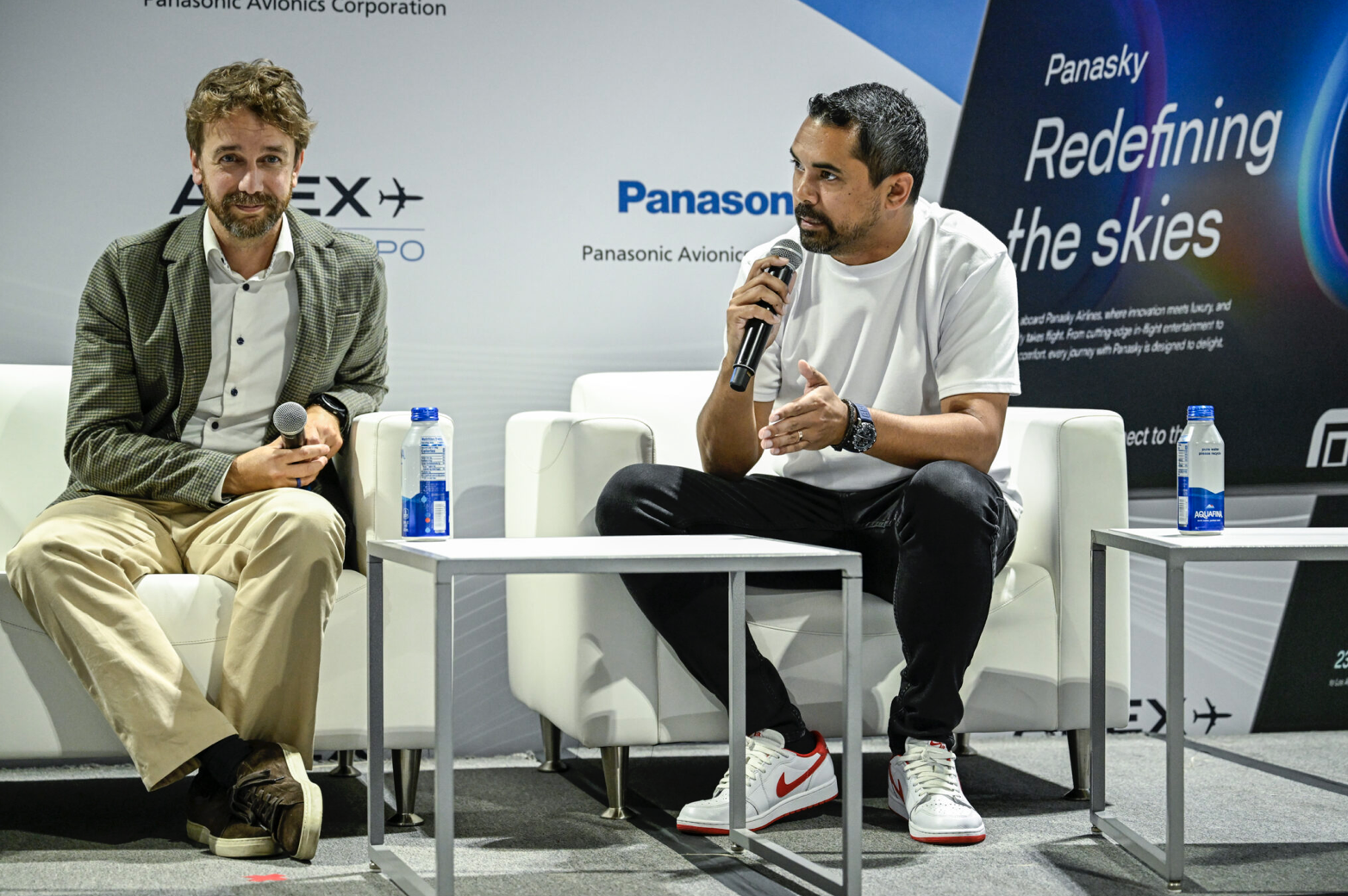
Pictured (left to right): SAS Scandinavian Airlines VP Product and Loyalty Aron Backstrom; and IAG Performance and Operations Manager IFEC Strategy Mark Cheyney
Greenway took a broader view, questioning whether connectivity is becoming a right. “Everywhere you go now there is an expectation you have internet,” he said. “Whether it is a bus, subway, or airplane, customers think it should be there. Is it a human right? I will leave that for others, but I believe it is now embedded in the standard full-service offering. Just like flatbeds or doors in business class, I think free high-speed Wi-Fi is becoming a benchmark.”
For low-cost carriers, the economics remain a challenge. “As an LCC, how do I pay for it?” Greenway asked. “It is another cost layer in a business model where every dollar matters.” He added that flyadeal is no longer just a short-haul domestic carrier, which changes the calculus.
“We are at a junction now. In the next six months we need to make a decision. You have to spec your aircraft two years before they arrive. We are getting all the wiring and all the infrastructure built into the aircraft already. We have not made a decision, but I am making sure that if we do, the aircraft are ready to go in terms of all the setup.”
Connectivity as the New Entertainment Standard
The panel then explored the evolving role of in-flight entertainment and connectivity, with sharp contrasts in how airlines are approaching the balance between cost, technology, and passenger expectations.
Backstrom said SAS is not prioritizing large-scale upgrades to legacy seatback systems. “There are some really cool use cases out there, but it is a big effort to make them happen,” he said. Instead, SAS is focusing on personal devices as the main platform for engagement. Seatback systems will continue to exist, but the emphasis is shifting toward a bring-your-own-device model supported by reliable connectivity.
Greenway challenged the premise of airline-provided entertainment, recalling his experience at Scoot, where the team removed nearly two tons of IFE equipment from a Boeing 777 fleet. “We had nothing on board, and in my six years at Scoot I never got one complaint,” he said. Passengers already carried iPads and laptops filled with content. “Your personalization is already on your phone or tablet. I do not need the airline to tell me what I should watch. Just give me connectivity.”

Pictured (left to right): PaxEx.aero Editor Seth Miller; flyadeal CEO Stephen Greenway; SAS Scandinavian Airlines VP Product and Loyalty Aron Backstrom; and IAG Performance and Operations Manager IFEC Strategy Mark Cheyney
Miller noted the long-standing idea of an “airworld,” where curated programming shaped viewing habits. “There are certain movies that I will only ever watch on airplanes,” he said, suggesting that airline curation historically created shared experiences distinct from those on the ground.
Backstrom suggested the industry is moving on. “We are going to be a bit nostalgic looking back to air travel in the 2020s when you did not have high-speed internet,” he said. “It was something different to be in that aircraft. But I am not sure that it is a bad thing.” In his view, the rise of connectivity is less about losing something unique and more about aligning with passenger expectations for personalization and choice.
The Next Frontier in IFC
As the panel closed, Miller asked what each participant would fix with unlimited resources.
Cheyney focused on simplicity. “One of the biggest pain points is connecting to the portal,” he said. “The captive network can be flaky, QR codes do not always work, and finding the right network is not always obvious.” Despite efforts to simplify access, the process still adds friction.
His vision is a seamless, secure, one-click experience that removes guesswork for the passenger while preserving the portal’s role as a platform for engagement and loyalty. “If you are going to have that trade-off,” he said, “let us make getting to it as fast, seamless, and secure as possible.”
Backstrom pinned his hopes on Starlink. “It will provide fast, low-latency internet free to loyalty program members.” The next step is combining robust connectivity with a frictionless login through the SAS app, reducing the process to a single click. “At the end of the day, solving those small barriers is just as important as offering the bandwidth itself,” he said.
Greenway emphasized that the real challenge is commercial, not technical. “The technology works. What is stopping us today is that the commercial model is not mature enough for a low-cost carrier,” he said. Flyadeal is hedging by preparing aircraft with the necessary wiring, ensuring they are ready when pricing structures evolve.
He predicted that within six to 12 months, providers will introduce more flexible models suited to low-cost airlines. “Once the commercial model matures, then I would be very interested in rolling it out across our growth fleet,” he said.
